
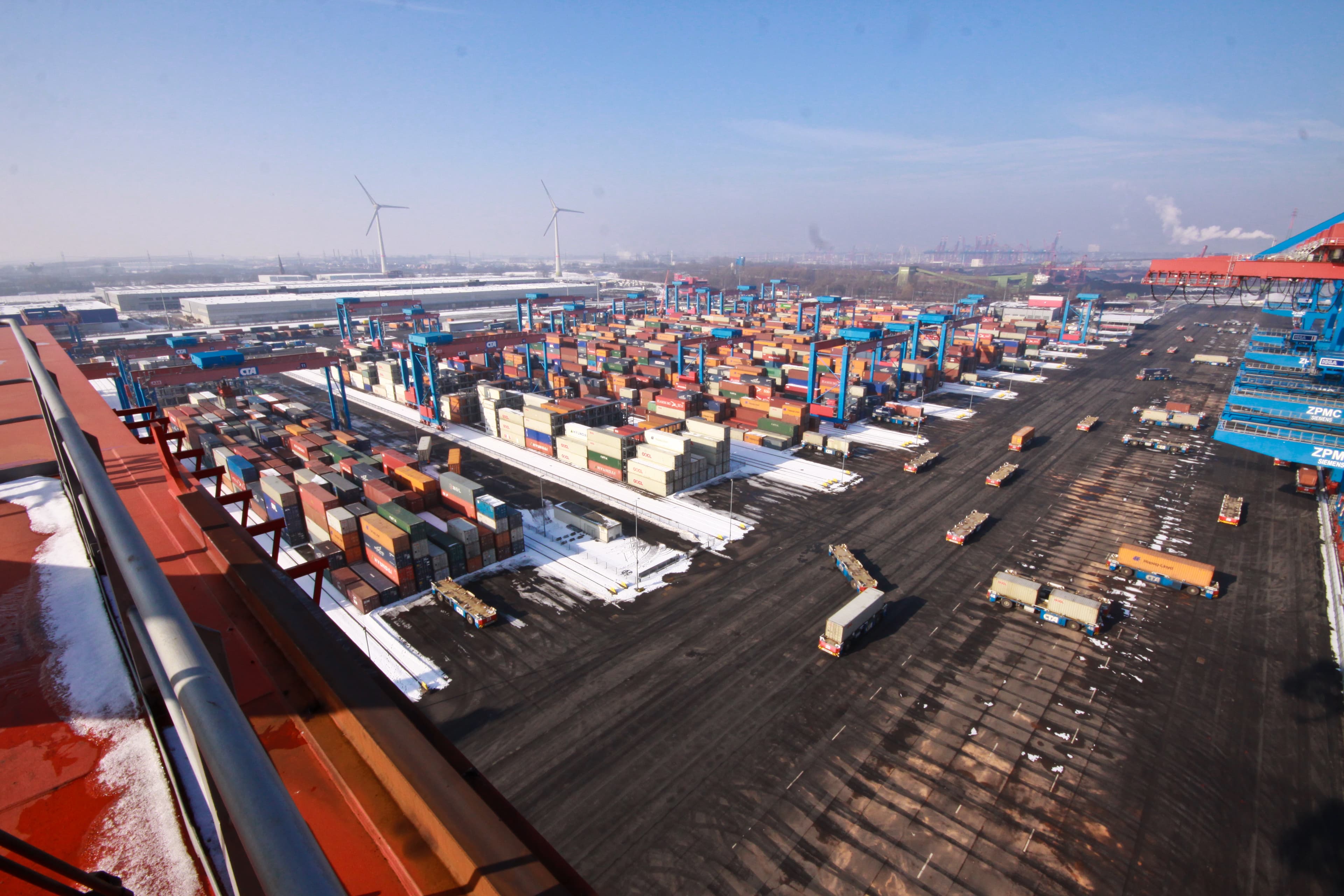

On the route from China to Poland, a full container (FCL) usually starts to pay off at around 15 m³ of goods. For smaller volumes LCL works out cheaper, but it takes 5–10 days longer. Between 15 and 20 m³ we price both options in the quote, because the details decide: weight, packaging, deadline and ports.
In this article we explain how the two options differ, how each one is priced and when to choose which. For a general description of the service, see FCL and LCL sea freight.
How FCL differs from LCL
FCL (Full Container Load) is a container booked for you alone. The supplier usually loads it at their own factory, the container is sealed and it reaches Poland in that state. At the destination port it's collected from the container yard (CY) at the terminal and taken on a trailer to your warehouse.
LCL (Less than Container Load), also known as groupage, is space in a shared container. Your goods go to a consolidation warehouse at the port (a CFS, container freight station). There they're loaded into one container together with other companies' shipments. When it arrives in Gdańsk or Gdynia, the container is unpacked at a warehouse and each shipment is cleared and released separately.
This leads to differences you'll notice in practice:
- price: with FCL you pay a fixed rate per container, with LCL per m³ or per tonne
- time: LCL usually takes 5–10 days longer, because of consolidation in China and unpacking in Poland
- handling: with FCL your goods are moved when the container is loaded and unloaded; with LCL they're also handled at two warehouses
- minimum: LCL starts from around 1 m³, which is roughly one pallet; with FCL you pay for the whole container, however much is in it.
20′, 40′ and 40′ HC containers – how much really fits
You can't fill a container to the last centimetre, because there's always some space left between cartons. So as well as the capacity, it's worth knowing how much cargo you can realistically load:
- 20′ – approx. 33 m³, realistically around 25–28 m³ of goods. Good for heavy cargo such as tiles or metal parts, because it reaches its weight limit before it runs out of space.
- 40′ – approx. 67 m³, realistically around 55–58 m³.
- 40′ HC (High Cube) – approx. 76 m³, realistically around 65–68 m³. It's 30 cm taller than a standard 40′ and the most popular container from China.
With heavy goods it's the weight, not the volume, that decides how much you can load. We check the maximum payload when we prepare the quote, because it depends on the container and on delivery by road in Poland.
How FCL and LCL prices are calculated
With FCL you pay for the container as a whole. The freight, port charges and delivery cost the same whether the container is full or half empty. The better you fill it, the less you pay per m³.
With LCL you pay for the space you take up. The rate is charged per m³ or per tonne, whichever works out higher – in LCL sea freight 1 m³ is treated as 1 tonne. Two examples:
- 3 m³ of cartons weighing 900 kg: you pay for 3 m³
- 2 m³ of metal parts weighing 3,200 kg: you pay as if it were 3.2 m³.
On top of the freight come the consolidation warehouse charges in China and in Poland, usually also charged per m³. These are what make LCL stop paying off for larger shipments.
Indicative freight rates (September 2026, net, excluding duty and VAT, Shanghai or Ningbo → Gdańsk):
- 40′ HC container: USD 3,500–5,000, most often USD 4,000–4,500
- 20′ container: USD 2,000–3,000
- LCL: USD 120–230 per m³
- port charges and delivery of a full container: an extra USD 700–1,500.
Rates change every week, and the binding price is the one in the quote we prepare for your cargo. To see which option pays off, multiply your m³ by the LCL rate and add the warehouse charges at both ends. Compare the result with the total for a 20′ or 40′ HC container, including port charges and delivery. At around 15–20 m³ the two figures are usually close, and then it comes down to the deadline, the weight or how fragile the goods are.
How to calculate CBM correctly
CBM stands for cubic metre. It drives the LCL price and the choice of container, so a measuring mistake comes back to you on the invoice.
- Measure the carton or pallet after packing: length × width × height in metres, multiplied by the number of units.
- Take the dimensions from the supplier's packing list, not from the product sheet.
- Check whether the goods can be stacked. If they can't, the pallets will take up more space than their combined volume suggests.
- Allow a margin for uneven cartons and parts that stick out.
You can get a first estimate of the volume from our CBM calculator. With LCL, the final m³ figure comes from the measurement at the consolidation warehouse. If it's higher than declared, the price goes up.
When to choose a full container (FCL)
A full container makes sense when:
- you have around 15 m³ of goods or more, or heavy cargo that will fill a 20′ by weight
- the goods are fragile or valuable and you don't want them handled at warehouses
- timing matters, because FCL skips consolidation and arrives sooner than LCL
- you import regularly and can plan deliveries in full containers
- you buy from several suppliers – we'll collect the goods at a warehouse in China and send them together in one container.
An example from our work: a 40′ HC of homeware bought on FOB terms, on the route Ningbo → Gdańsk → Poznań. It took 42 days from the factory to the client's warehouse. More about this route: sea freight from China.
When to choose LCL
LCL works well when:
- you have less than around 15 m³ of goods, even a single pallet
- you're testing a new supplier or product and don't want to tie up money in a large order
- you're topping up stock between larger deliveries
- the goods are ready now and filling a full container would mean waiting for weeks.
If you go for LCL, pay attention to packaging. Cartons should be on pallets, stretch-wrapped and labelled on every side, because the shipment passes through two warehouses and is handled several times.
We also arrange LCL from other origins. In 2026 we moved goods this way for a client from the Czech Republic: collection from the supplier in India (EXW), then from the port of Mundra via Gdańsk to Ostrava – 45 days in total.
FCL, LCL and your purchase terms
With LCL, be especially careful about buying on CIF. The supplier pays the freight to Poland, but the charges at the destination port are set by the agent from its own price list. Sometimes USD 500 of freight ends with a bill of USD 3,000–4,000 for port charges in Gdańsk. For your first import it's worth buying on FOB or EXW – that way you know the full transport cost upfront from the quote.
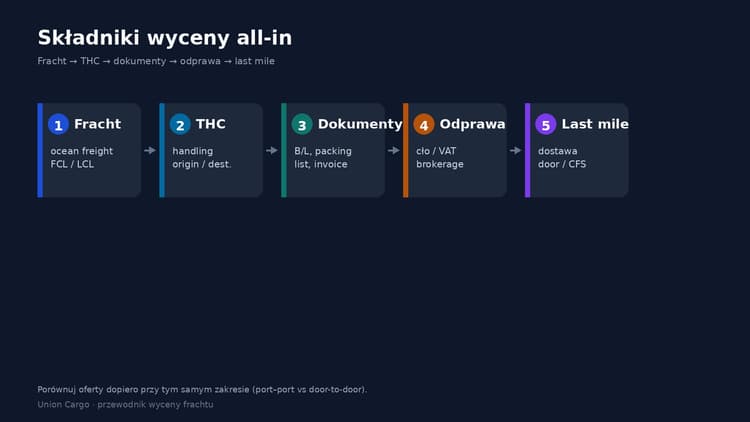
We explain how to read a quote like this and compare offers in How to read an ALL-IN freight quote.
What about rail?
If LCL from China takes too long for you, compare it with rail freight. Rail takes around 14–22 days terminal to terminal and usually costs around 1.5 times as much as sea freight. Here too you choose between a full container and LCL: full containers are 40′ HC only, while LCL can be sent even below 1 m³ and arrives at Pruszków near Warsaw. Details: rail freight from China.
Frequently asked questions
How many m³ do I need for a full container to pay off?
Usually from around 15 m³ of goods. Between 15 and 20 m³ we price both options in the quote, because the result depends on the weight, the route and current rates.
How much longer does LCL take?
Usually 5–10 days longer than a full container, because of consolidation in China and unpacking the container in Poland. The sea voyage itself from China to Gdańsk takes around 35–45 days port to port.
How is the LCL price calculated?
Per m³ or per tonne, whichever works out higher (1 m³ = 1 t). On top of the freight come the consolidation warehouse charges in China and in Poland.
Can I send a single pallet as LCL?
Yes. LCL sea freight starts from around 1 m³, which is roughly one pallet.
Can a full container be delivered to my warehouse?
Yes. After clearance the container goes on a trailer to the address you give us, and after unloading it returns empty to the depot. Plan space for unloading, and people or a forklift to do it.
What happens if my LCL shipment measures more m³ than declared?
You pay according to the measurement at the consolidation warehouse. That's why you should give us packed dimensions for the quote, ideally from the packing list.
Summary
Below around 15 m³, LCL is usually the better choice; above that, a full container. For borderline volumes, the weight, the deadline and how well the goods cope with repeated handling decide. Send us your cargo details – we'll prepare an individual quote for both options and advise which one to choose. Go to the quote form.

Comments
No comments yet. Be the first to share your opinion.