
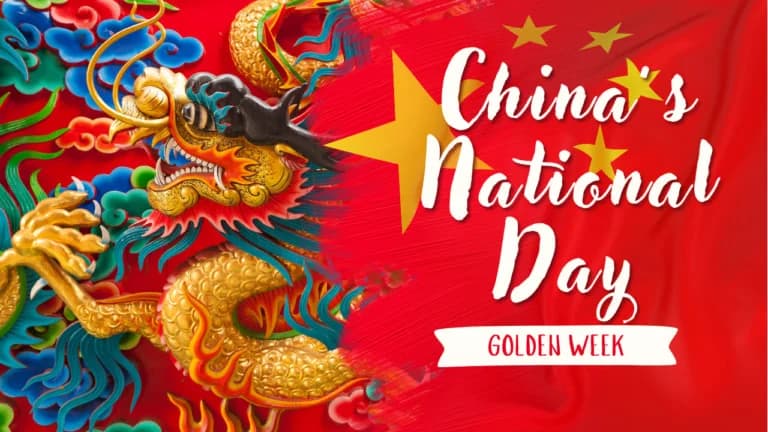

China's Golden Week is much more than just a festive period. It is an annual, nationwide event that almost completely paralyses the world's second largest economy for more than a week, creating a powerful knock-on effect on global logistics. If you're planning to import from China, ignoring this period is a straightforward route to costly delays, unforeseen expenses and broken deadlines. This article is a comprehensive guide that will take you through all stages of China's Golden Week 2026. You will learn how the mechanics of this logistical challenge work, what pitfalls lurk for importers and - most importantly - how to strategically manage your orders and transport to turn risk into competitive advantage. This is a must-read for anyone who wants to avoid problems and ensure continuity of supply during the most critical time of the year.
What exactly is Golden Week in China and why is it so important?
Golden Week is the name given to the seven-day (and in practice often longer) public holiday in China. The main celebrations centre around the National Day, which falls on 1 October and commemorates the proclamation of the People's Republic of China in 1949. The Chinese government deliberately extends the period by combining it with weekends and introducing extra working days before or after to create a long, uninterrupted week off. The aim is to stimulate domestic tourism and consumption as Chinese people travel en masse, visit family and spend money.
From a business perspective, especially for global trade, Golden Week is a time of great significance. It is the largest synchronised break in manufacturing and administrative activity in the Middle Kingdom. Unlike holidays in Western culture, where companies often operate on a limited basis, here most factories, offices, customs and government agencies are completely closed. This shutdown of the production machinery in the 'factory of the world' has direct and tangible consequences for international supply chains, affecting every importer and every business partner working with China.
When is Golden Week in China in 2026?
In 2026, Golden Week runs from Thursday 1 October to Wednesday 7 October – 7 days off. To make the break longer, the Chinese government has rescheduled working days: Sunday 20 September and Saturday 10 October are working days in China. The government announces this calendar in advance – the holiday schedule for 2026 was published on 4 November 2025. Still, ask your supplier which days they will be closed – many companies set their own break.
Many factories extend the break: they close a few days earlier or return to work a few days later. The actual standstill can therefore last up to 10–14 days. In 2026, the Mid-Autumn Festival also falls just before Golden Week – days off from Friday 25 to Sunday 27 September. Only three working days (28–30 September) remain between the two holidays. Anyone who takes them off has 13 consecutive days off, from 25 September to 7 October. That is why some suppliers may start their break as early as the end of September. Put these dates in your calendar – it is the first step to good planning.
How do the Chinese celebrate this national holiday?
Golden Week is one of the few opportunities a year for millions of Chinese to relax and travel for an extended period. Massive population migrations are celebrated during this time, with hundreds of millions of people moving across the country to visit family in their hometowns or to visit popular tourist attractions. Public transport, including trains and planes, is overcrowded and ticket prices soar. It is also a time of patriotic celebrations; official ceremonies, military parades (especially on round anniversaries) are held across the country and fireworks displays light up the sky in the evenings.
For the domestic economy, this golden period is a huge boost. Shopping centres are under siege, restaurants are full and tourist destinations are recording record revenues. But for the rest of the world, which relies on Chinese manufacturing, this festive mood has a very different dimension. This is the week when contact with Chinese partners is virtually impossible. Emails go unanswered, phone calls go silent and attempts to confirm the status of orders fail. Understanding this cultural context is key to understanding why attempts to 'expedite' anything during this period are doomed to failure.
What is the real impact of Golden Week on transport and imports from China?
The impact of Golden Week on global supply chains is powerful and multi-stage. It is not a one-off event, but a process that begins well before 1 October and ends weeks after 8 October. The first and most obvious impact is a complete shutdown of production. Every factory in China stops working, meaning that no new goods are produced and orders started are not completed. This in turn leads to unavoidable delays in order fulfilment, which can accumulate and affect schedules for months ahead.
Secondly, logistics are coming to a standstill. Ports, such as the one in Shanghai, are operating on a very limited basis, mainly receiving ships, but loading and unloading operations are slowing down. Customs clearance and transport to the port slow down considerably – even cargo that is ready at the factory may have to wait a long time for dispatch. For the importer, this means that his delivery is frozen in the system for at least a week. This logistical bottleneck is the main reason why planning well in advance is so crucial if you plan to import from China.
Why is the run-up to Golden Week a logistical nightmare?
The weeks immediately preceding Golden Week - mainly the whole of September - are what is known in the logistics industry as 'pre-Christmas fever'. Knowing of the impending shutdown, all companies in China try to produce and ship as many goods as possible before factories and offices close. This is leading to a surge in demand for transport services. Demand for sea, air and rail freight is exploding, and with it prices.
What is happening in China from 1 to 7 October?
As it strikes midnight from 30 September to 1 October, China's economy presses the 'pause' button. From 1 to 7 October, business life in China freezes. Factories halt production and production halls become empty. Employees, who often work far from their family homes, use this time to travel and spend with their loved ones. This means that there is absolutely no possibility of any production processes continuing.
Communication with suppliers and business partners becomes impossible. Your emails go unanswered and your phone calls go silent. There is no hope of confirming production status, obtaining shipping documents or resolving any problem. Logistics operations are frozen. Even if the goods arrived at the port before the holiday, their customs clearance slows down considerably. It is a state of logistical limbo in which the only thing to do is wait.
What is the 'domino effect' of the post-Christmas holiday in the Middle Kingdom?
In theory, as soon as the Golden Week is over, everything should return to normal. In practice, however, the system needs at least two to three weeks to regain full performance. The first problem is the slow start-up of factories. Many workers return to work late and it takes time to reach full capacity. For the first few days, productivity is much lower than usual, generating further delays in orders that were already held up for a week.
The second problem is the 'uncorking' of the ports. The huge number of cargoes that were waiting to be shipped before the holiday, and those that were prepared immediately afterwards, creates gigantic queues. Container terminals are working at top speed, but it takes time to process all the backlogs. The phenomenon of so-called 'blank sailings' (empty voyages) often occurs during this period. Shipowners, expecting less cargo right after the holiday, often cancel ship calls at certain ports to optimise their routes. This further complicates planning and forces them to look for alternative, often more expensive, transport connections. The risk of delays is still very high during this time.
One such alternative is rail. Rail transport from China is faster than sea freight and cheaper than air freight. It makes particular sense when you face a sales deadline after the break, such as Black Friday or Christmas. Send us your cargo details and the expected delivery date – we will compare the cost and transit time of sea and rail transport.
What are the biggest mistakes that importers of goods from China make during this period?
The biggest and most common mistake is a lack of awareness and ignoring the existence of Golden Week. Many, especially novice importers, only become aware of the holiday when their supplier stops responding to emails and deliveries do not get off the ground. This results in panic and chaotic attempts to salvage the situation, which are rarely successful. Another mistake is placing orders too late. Assuming that an order placed in early September will be delivered before the holiday is very risky and often ends in disappointment.
Another stumbling block is the lack of communication with the supplier. Instead of having an open dialogue and creating a schedule together, many importers simply send an order and expect it to be fulfilled. They do not ask about the factory's production plans, the final dates for accepting orders before the holiday or when they are scheduled to return to full capacity. The last major mistake is the lack of a safety buffer. Companies that operate without adequate stock levels in their warehouses are completely reliant on on-time delivery. Any delay, even the slightest one, during Golden Week can mean empty shelves and lost sales for them.
How to strategically plan orders and transport to avoid problems?
The key to pain-free passage through Golden Week is anticipation and strategic planning. Instead of reacting to problems, prevent them well in advance. The first step is intensive communication with your Chinese supplier, which should start as early as July or early August. Treat him as a business partner - ask about his production plans, the deadline for orders to be shipped before the holiday, and when he expects work to resume. Together, create a realistic timetable that safeguards your interests.
The second pillar of the strategy is to book freight early. Instead of waiting until the last minute, book your transport 3-4 weeks before the peak, that is, as early as August or early September. This is not a cost, it is an investment in peace of mind and predictability. It will ensure that you have space on board and a stable price, while your competitors are paying 'last minute' rates or waiting for the next available ship. Thirdly, build a safety buffer. Consciously stocking your warehouse in Europe will allow you to make sales smoothly when others are nervously checking the status of their delayed containers.
Is Golden Week the only Chinese holiday to watch out for?
Although Golden Week is one of the most onerous periods of logistics with China, it is not the only holiday to include in your calendar. The absolute most important and longest holiday on the Chinese calendar is Chinese New Year (also known as Spring Festival). This is a movable holiday, celebrated according to the lunar calendar, which usually falls in late January or early February. In 2027, Chinese New Year is on 6 February. The break then lasts even longer, often two to even four weeks, and its impact on global supply chains is even more acute than that of Golden Week.
In addition to these two major periods, the Chinese holiday calendar also includes several other shorter public holidays, such as the Qingming Festival (usually in April), Labour Day (in 2026, days off from 1 to 5 May) and the Dragon Boat Festival (usually in June). Although the interruptions are shorter then (in 2026, from 3 to 5 days), they can also cause minor delays and disruptions in communication. Therefore, it is crucial to have an up-to-date calendar of Chinese holidays and take them into account in your annual procurement and transport planning. Ignoring these dates is asking for trouble.
Summary: The most important things to remember
- Golden Week 2026 officially runs from 1 to 7 October (10 October is a working day in China), but the real disruption to production and logistics starts as early as September and lasts until the end of October.
- Communication is key: Talk to your suppliers as early as August about their production plans and timetable related to the festive period.
- Plan ahead: Place your orders and book your freight no later than the beginning of September to avoid a drastic increase in costs and lack of availability.
- Build a stock buffer: Increase the level of stock in your warehouse to safeguard sales continuity in the event of unavoidable delivery delays.
- Expect delays: Even with the best planning, the period after Golden Week is characterised by a slowdown and the risk of further disruption. Be prepared for this.
- Remember other holidays: Chinese New Year (6 February in 2027) has an even greater impact on supply chains than Golden Week. Order your goods and book transport well in advance.



Comments
No comments yet. Be the first to share your opinion.