
Alibaba.com is one of the world's largest B2B platforms: businesses use it to buy goods directly from manufacturers and wholesalers, most of them in China. It lists millions of products across a huge range of categories – from electronics and homeware to machinery. Prices are wholesale, and many listings have a minimum order quantity of, say, 100 or 1,000 units. Anyone can open a free account, including private individuals. So how do you buy on Alibaba? Registering takes a few minutes. What needs more care is everything that follows: choosing a supplier, ordering samples, paying and arranging transport to Poland.
We wrote this guide on 8 October 2026. To show the whole process, we went through it step by step with one product – bamboo chopping boards – from the search results and the product page to the supplier profile and the request for quotation. The screenshots and prices date from that day. They come from the Polish-language version of Alibaba.com, which is why prices appear in złoty; you can switch the site to English or another language in the top bar.
In brief – how to buy on Alibaba:
- Open a free account on Alibaba.com (an email address or a Google account is enough).
- Search for your product and turn on the Verified Supplier and Trade Assurance filters.
- On the product page, check the unit price for your quantity and the MOQ, or minimum order quantity.
- Check the supplier: is it a manufacturer, how long has it been trading, where is its factory and what do its reviews say?
- Send an inquiry to several suppliers and compare their replies.
- Order samples before you order the full batch.
- Put the terms in writing: specification, production lead time, Incoterms rule and packaging.
- Pay through Alibaba.com – only then is your order covered by Trade Assurance.
- Arrange a quality inspection before shipment, then organise transport to Poland and customs clearance.
What is Alibaba.com and how is it different from AliExpress and 1688?
Alibaba.com was launched in 1999 in Hangzhou. It belongs to China's Alibaba Group, as do AliExpress and 1688.com. They share a name, but each serves a different purpose.
Alibaba.com | AliExpress | 1688.com | |
|---|---|---|---|
Who it is for | businesses (B2B), wholesale | retail customers (B2C) | the Chinese domestic wholesale market |
Quantity | usually from a few dozen to several thousand units (MOQ) | from 1 unit | wholesale, often very large quantities |
Price | wholesale, negotiable | retail, fixed | wholesale, in yuan |
Language | English, Polish and others | Polish, English and others | Chinese |
Shipping to Poland | depends on what you agree; often arranged by the buyer | included or for an extra charge | suppliers usually ship only within China |
Customisation (logo, packaging) | yes, it is standard practice | rarely | possible, but hard without Chinese |
Put simply: AliExpress is a shop where you buy one item for yourself. Alibaba is where you find a manufacturer, negotiate and order a batch of goods – to resell or to use in production.
Can a private individual buy on Alibaba?
Yes. Buying on Alibaba as a private individual is legal and perfectly possible – the account is free, and you do not need a company or a tax number to register. As an individual, you can search for products, contact suppliers and place orders.
There are, however, a few limitations to bear in mind:
- MOQ. Many listings have a minimum order quantity. Only some suppliers will sell you a single unit – and usually at more than the wholesale price.
- Suppliers prefer businesses. For large orders and production with your logo, some will ask for company details. Smaller orders are usually accepted without any fuss.
- Private purchases are subject to customs duty and VAT too. Since 1 July 2026, parcels worth up to EUR 150 are no longer exempt from customs duty. More on this in the customs section below.
If you are buying goods to resell, it is better to order as a company from the start. The invoice will be issued to your business, you can reclaim import VAT, and you will use your EORI number for customs clearance.
How to buy on Alibaba step by step
Step 1. Open an account on Alibaba.com

On the home page, click the sign-up button in the top right corner. Enter your email address or use your Google, Facebook or LinkedIn account. Alibaba will then ask for a few basic details and for you to confirm your email address. Registration is free and takes a few minutes.
You can use Alibaba in several languages and display prices in your own currency. That makes the first steps easier, but not much more: product descriptions and conversations with suppliers are usually in English anyway, and the local-currency price is just a conversion from US dollars. What counts is the amount the supplier quotes in their offer.
Tip: enter your real details in your account settings and, if you are buying for a business, your company name. Suppliers reply more readily, and faster, to buyers with a complete profile.
Step 2. Search for products and set filters

Type the product name into the search bar – ideally in English, as that is how suppliers describe their listings. We searched for “bamboo cutting board”. There were more than 10,000 results, so without filters it is easy to get lost. You can also search by image using the camera icon in the search bar.
In the left-hand column, set:
- Trade Assurance – shows only listings covered by order protection (more on this in step 8).
- Verified Supplier – suppliers whose details have been checked by an independent inspection company on Alibaba's behalf.
- Store reviews – for example 4.5 and above.
- Product features → Paid samples – if you want to order a sample straight away.
Also switch the tab from “Products” to “Suppliers”. You will then see companies rather than individual listings, which makes it easier to compare their profiles.

Each company card shows the key facts at a glance: the Verified badge, years on Alibaba, approximate revenue, rating with the number of reviews, and response time. In our example, one supplier had a rating of 4.6/5 from 98 reviews, while another had 0.0/5 because it had no reviews yet.
Results marked “Ad” are adverts. The supplier has paid to be displayed, so a result at the top of the list is not necessarily the best choice.
Step 3. Read the product page: price, MOQ, customisation

On the product page, focus on four things:
- The price depends on the quantity. The board in our example cost 33.87 zł (PLN, Polish version of Alibaba) for 10–999 units and 25.30 zł from 1,000 units (8 October 2026). The price on the page is a starting point for negotiation, not the final amount.
- MOQ, or minimum order quantity. For the standard board it was 10 units, but for a custom shape it rose to 1,000 units. Customisation, such as a logo or printed packaging, almost always pushes the MOQ up. Read more: what does MOQ mean.
- Shipping cost. Alibaba shows an indicative transport cost. In our example, it was sea freight from 1.49 zł/kg with a 50 kg minimum and a transit time of around 24–31 days. This is an estimate – the final price depends on the delivery address, weight and volume.
- Product attributes. Material, dimensions, thickness, packaging. Compare them with your own specification. Photos can flatter a product; dimensions are hard facts.
Below the “Send inquiry” and “Chat now” buttons, there is a note that Alibaba's protection only covers orders placed and paid for through Alibaba.com. We will come back to this when we get to payment.
Step 4. Supplier verification – check the seller before you get in touch

This step matters more than any other. Even a good product from a weak supplier is a risk. Click the company name on the product page and open the “Company profile” tab. What to look for:
- Business type: manufacturer or trading company. A manufacturer usually offers lower prices and has more control over quality. A trading company can be useful when you are ordering several different products at once. The supplier in our example listed both types in its profile. That is common – in that case, ask what it actually makes itself.
- Years on Alibaba. The badge next to the name, for example “14 yrs”, shows how many years the company has had an account on the platform. Gold Supplier status, on the other hand, means the supplier pays for a membership. Neither a long track record nor a paid account proves reliability, though – they are simply good signs.
- Response time and sales record. A quick reply (for example within 12 hours) and a history of transactions through Alibaba show whether the company really sells on the platform.
- Verified Supplier. This means an independent inspection company has checked the company's details, and often its factory as well. You will usually find the verification report in the profile.
- Certificates. A supplier profile usually has a tab with certificates (for example ISO 9001) and product test reports. Ask for copies and check that they relate to the product you are buying.
- Transactions and reviews from other buyers. Pay particular attention to reviews about product quality, lead times and after-sales contact with the seller.
On top of that, ask the supplier for a copy of its Chinese business licence and check its USCC number – the Chinese equivalent of a company registration number. We explain how to do this in our guide to verifying Chinese counterparties by USCC. The company name on the licence should match the one on Alibaba and on the invoice.
Step 5. Send an inquiry to several suppliers

To contact one supplier, use the “Send inquiry” or “Chat now” button on the product page. If you would rather have suppliers come to you, post a request for quotation (RFQ). You describe what you need, and suppliers interested in the order send you their offers. You will find the form under the “Request for Quotation” button on the home page.
A good inquiry is short and specific. The supplier can see straight away that they are dealing with someone who knows what they want. For example:
Hello, we are a company from Poland. We are looking for 500 bamboo cutting boards, 30 x 20 x 1.5 cm, with laser engraved logo, each board packed in a printed carton box. Please send us: unit price for 500 and 1000 pcs, MOQ, production time, packing details (carton size, weight, pcs per carton) and price of a sample. Price FOB or EXW, please.
Contact 3–5 suppliers and compare their replies. Price alone is not enough – also check whether the supplier answered every question. Pressure to pay outside Alibaba, or a price far below everyone else's, is a sign to stop and think.
Step 6. Negotiate and order a sample
The price on the product page is usually just the opening of the conversation. You have the most room to negotiate with larger quantities and the prospect of a long-term relationship; a flexible deadline helps too. And it is not only about price – you can also negotiate a lower MOQ, better packaging, a shorter lead time or a free sample.
Before you order a batch, order samples. You usually pay for the sample and its express delivery, but it is the cheapest way to check quality. If you are having goods made with your logo, ask for a pre-production sample – one made to your specification. Once you approve it, photograph it and keep it: it is the reference you will compare the whole batch against later. Read more: ordering samples from China.
Step 7. Put the order terms in writing
Before you pay, agree the following in writing (in the order on Alibaba or in a proforma invoice, PI):
- Specification: material, dimensions, colour, logo, markings, packaging and the number of units per carton.
- Production lead time and the date the goods must be ready for pickup.
- The Incoterms rule, which sets out who pays for transport and bears the risk, and up to which point. You will most often come across three:
- EXW – you collect the goods from the supplier's factory; your freight forwarder arranges transport within China (Incoterms EXW).
- FOB – the supplier delivers the goods to a port in China and clears them for export (Incoterms FOB).
- DDP – the supplier delivers the goods to your address with duty and taxes paid. Convenient, but check who will be named as the importer on the documents and whether the price includes VAT (Incoterms DDP).
- Documents: a commercial invoice and a packing list with the weight, number of cartons and volume in m³. Without them, you cannot clear customs.
- EU market requirements. If the product needs CE marking, ask for a declaration of conformity and test reports. For products that come into contact with food, such as chopping boards, ask about testing for compliance with EU rules.
Step 8. Pay through Alibaba.com (Trade Assurance)

Trade Assurance is Alibaba's order protection programme. It works like this:
- You agree the terms with the supplier, and the supplier creates the order on Alibaba.
- You pay through Alibaba.com – by card, bank transfer or digital wallet.
- The money goes into an escrow account. According to Alibaba, the supplier receives it once the goods have been delivered and you have confirmed receipt.
- If the order was not shipped, went missing or the goods do not match what was agreed, you can file a refund claim. Alibaba mediates the dispute.
The golden rule: the protection only applies when you pay through Alibaba.com. If a seller asks you to pay by transfer to a personal account, via Western Union, through PayPal “friends and family” or to the account of a company other than the one in the profile – say no. Such a transaction is not protected. This is a common scam when buying from China. If you do pay by bank transfer outside the platform, pay only into the account of the company you have a contract with. Read more: how to send payments to Chinese companies.
With made-to-order production, it is common to pay a 30% deposit before production starts and 70% before shipment. Trade Assurance then covers both payments, as long as both go through Alibaba.
A word on disputes: Alibaba assesses a claim against what is written in the order – whether the goods match what was agreed. That is why the detailed specification from step 7 matters so much. “Poor-quality goods” is hard to prove; “1.2 cm thick instead of 1.5 cm” is easy.
Step 9. Quality inspection before shipment
Once the goods are on their way, it is too late for corrections, and a complaint takes a long time. So for larger orders, arrange a pre-shipment inspection. An inspector visits the factory, counts the cartons, checks randomly selected units against your specification and takes photos. You only pay the balance once you have the report.
You can hire an inspection company yourself, or we can arrange the inspection for you – together with supplier verification and sample orders, if you would rather not handle these yourself. We quote for this individually.
Step 10. Transport to Poland and customs clearance
The last step is getting the goods to Poland. You have three options:
- Shipping arranged by the supplier or by Alibaba – convenient for small parcels. Check what the price includes: transport only, or customs clearance, duty and door-to-door delivery as well.
- Express courier – for samples and small, light shipments.
- Your own freight forwarder – for larger shipments, usually from a few dozen kilograms or from 1 m³. The forwarder collects the goods from the supplier (EXW) or from the port (FOB) and arranges transport to Poland, customs clearance and delivery to your address.
For customs clearance, you will need an EORI number (if you are buying as a company), the commercial invoice, the packing list and an authorisation for the customs agency. If you are based in Czechia or Romania, your goods usually arrive at our consolidation warehouse in Poland, where we issue a T1 transit document, and they are then cleared by a local customs agency in your country. We walk through the whole process in our guide to customs clearance for imports from China.
How much does shipping from Alibaba to Poland cost?
Shipping costs depend on weight, volume and the mode of transport. For a small shipment, transport can cost more than the goods themselves; with a larger order, its share of the unit price falls. Here are indicative figures for transport arranged through a freight forwarder (prices from September 2026, net, excluding customs clearance and delivery within Poland):
Transport | Transit time | Indicative price | When to choose it |
|---|---|---|---|
Air freight | 3–7 working days, airport of departure to destination airport | USD 4.50–6.00/kg for 100–300 kg | urgent, light and high-value goods |
Rail freight | approx. 14–22 days terminal to terminal | less than container load (LCL) USD 150–200/m³ | medium quantities, when both time and price matter |
Sea freight | 35–45 days port to port | less than container load (LCL) USD 120–230/m³ | large quantities and full containers |
On top of that come pickup from the supplier in China, customs clearance and delivery within Poland. That is why, when comparing offers, you should look at the “all-in”, or total, price. If you ship through Alibaba, check whether the amount covers the same elements. We explain how to read such a quote in how to read an all-in freight quote.
With small quantities, your goods do not need a container of their own. We also ship less than container load (LCL) by rail freight below 1 m³. If you buy from several suppliers, the goods can be collected in one warehouse in China and shipped together – this is consolidation of goods in China.
Customs duty and VAT on imports from China via Alibaba
Every import from China is subject to VAT (in Poland, usually 23%), and often to customs duty as well. The duty rate depends on the commodity code of the goods in the customs tariff.
- Buying as a company: customs duty at the tariff rate plus VAT, calculated on the value of the goods including transport costs to the EU border. A company can reclaim import VAT, and with clearance under Article 33a of the Polish VAT Act (once the conditions are met) it can account for it in its VAT return without paying it at the border.
- Buying privately, small parcel up to EUR 150: since 1 July 2026, a customs duty of EUR 3 applies to each item in the shipment (online sales to consumers), plus VAT.
- Buying privately, over EUR 150: customs duty at the tariff rate plus VAT, as with any standard import.
You will find example rates and calculations in our guide to customs duty and VAT on imports from China.
Is buying on Alibaba safe and legal?
The platform itself is legal and safe – it has been running for more than 25 years, and Alibaba states that Trade Assurance has covered over 160 million orders. The risk lies more in which supplier you choose and how you pay. The most common mistakes and how to avoid them:
- Paying outside Alibaba. You lose Trade Assurance protection. → Pay through the platform, or only into the company account of a verified supplier.
- Ordering without a sample. The goods look different from the photos. → Always start with a sample; for production with your logo, a pre-production sample.
- A vague specification. You have nothing to refer to if you need to complain. → Write down dimensions, material, colour, packaging and tolerances.
- Choosing on price alone. The cheapest offer often means poorer material, or a middleman instead of a factory. → Compare 3–5 suppliers and check each one's profile.
- Missing documents for the EU. Your goods can get stuck at customs. → Ask about CE marking, a declaration of conformity, certificates and test reports before you place the order.
- Counterfeit branded goods. Goods bearing someone else's logo can be detained by customs. → Only buy products without third-party trademarks, or with your own logo. Read more: importing counterfeit goods from China – the risks.
- Counting only the price of the goods. Transport, duty, VAT and clearance can push up the unit cost considerably. → Ask for a transport quote before you order and work out the full cost.
If something goes wrong despite all this, read how to deal with a dishonest counterparty from China.
Frequently asked questions about buying on Alibaba
Can I order from Alibaba to Poland?
Yes. For many products, Alibaba shows the delivery cost and time to Poland right away. For larger orders, you can also hand transport over to your own freight forwarder – the supplier then releases the goods to them at the factory (EXW) or at the port (FOB).
Can I order a single item on Alibaba?
Sometimes – some listings have an MOQ of 1 unit, and samples are usually ordered one at a time. Most suppliers, however, sell wholesale. If you need just one item for yourself, AliExpress is the easier option.
Do I need a tax number to open an Alibaba account?
No. Registration only requires an email address and basic details. A VAT number and an EORI number only come into play when you import as a company and clear goods through customs.
Is the MOQ final?
Not always. For a first order, many suppliers will agree to a smaller quantity, usually at a higher unit price. The MOQ is hardest to bring down for customised products, for example a custom shape, colour or logo.
How do I pay safely for an order on Alibaba?
Through Alibaba.com, under Trade Assurance – by card, bank transfer or digital wallet. The supplier only receives the money once the goods have been delivered and you have confirmed receipt, and if something goes wrong you can file a refund claim.
How long does delivery from Alibaba take?
First comes production – from a few days for goods in stock to several weeks for made-to-order production. Then transport: air freight 3–7 working days, rail freight approx. 14–22 days, sea freight 35–45 days (port to port or terminal to terminal). Add customs clearance and delivery within Poland. Before holidays in China, for example before Chinese New Year, everything takes longer.
Buying on Alibaba? We will handle transport and customs clearance for you
Found a supplier and got an offer? We organise the entire transport from China – from collecting the goods at the factory, through rail, sea or air freight, to customs clearance and delivery to your address in Poland. If you would rather not look for a supplier on your own, we can also help verify them, order samples and carry out quality inspections.
Send us your cargo details – we will prepare a tailored quote
Sources
- Alibaba.com – home page, search results, product page, supplier profile, request for quotation (RFQ); as of 8 October 2026: alibaba.com
- Alibaba.com – Trade Assurance: tradeassurance.alibaba.com
- Council Regulation (EU) 2026/382 – EUR 3 customs duty on small consignments: EUR-Lex
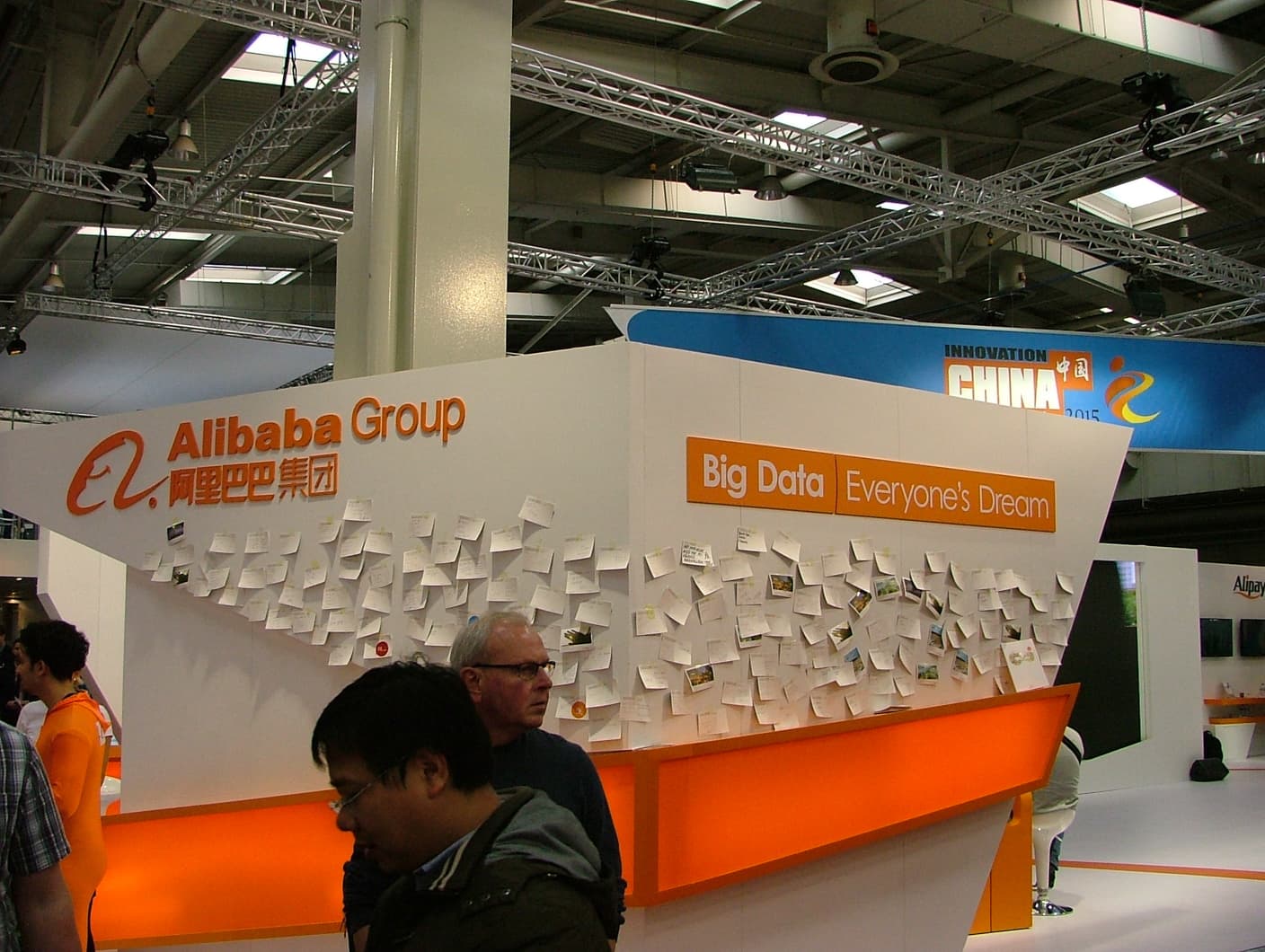
- Featured image: Alibaba Group stand at CeBIT 2015, photo by Olaf Kosinsky, licence CC BY-SA 3.0 DE, Wikimedia Commons

Comments
No comments yet. Be the first to share your opinion.